Section I
The Cosmic Purpose of Temples — Devalaya Tattva
A temple is not merely a building. It is the terrestrial body of the Divine — a living yantra constructed according to cosmic proportions, encoding the structure of the universe in stone, brick, and consecrated space. The Garbhagriha (sanctum sanctorum) at its core represents the cosmic womb (Hiranyagarbha) from which creation perpetually arises.
The Agamas — the revealed canon governing temple construction and worship — treat the Prasada (temple structure) as literally the body of the deity: the shikhara is the head, the sanctum is the heart, the walls are the limbs. The deity does not "reside" in an idol placed in an arbitrary room; the entire building, when properly proportioned and consecrated, is the deity's embodied form.
✦ Śāstric Architecture — Plan & Elevation ✦
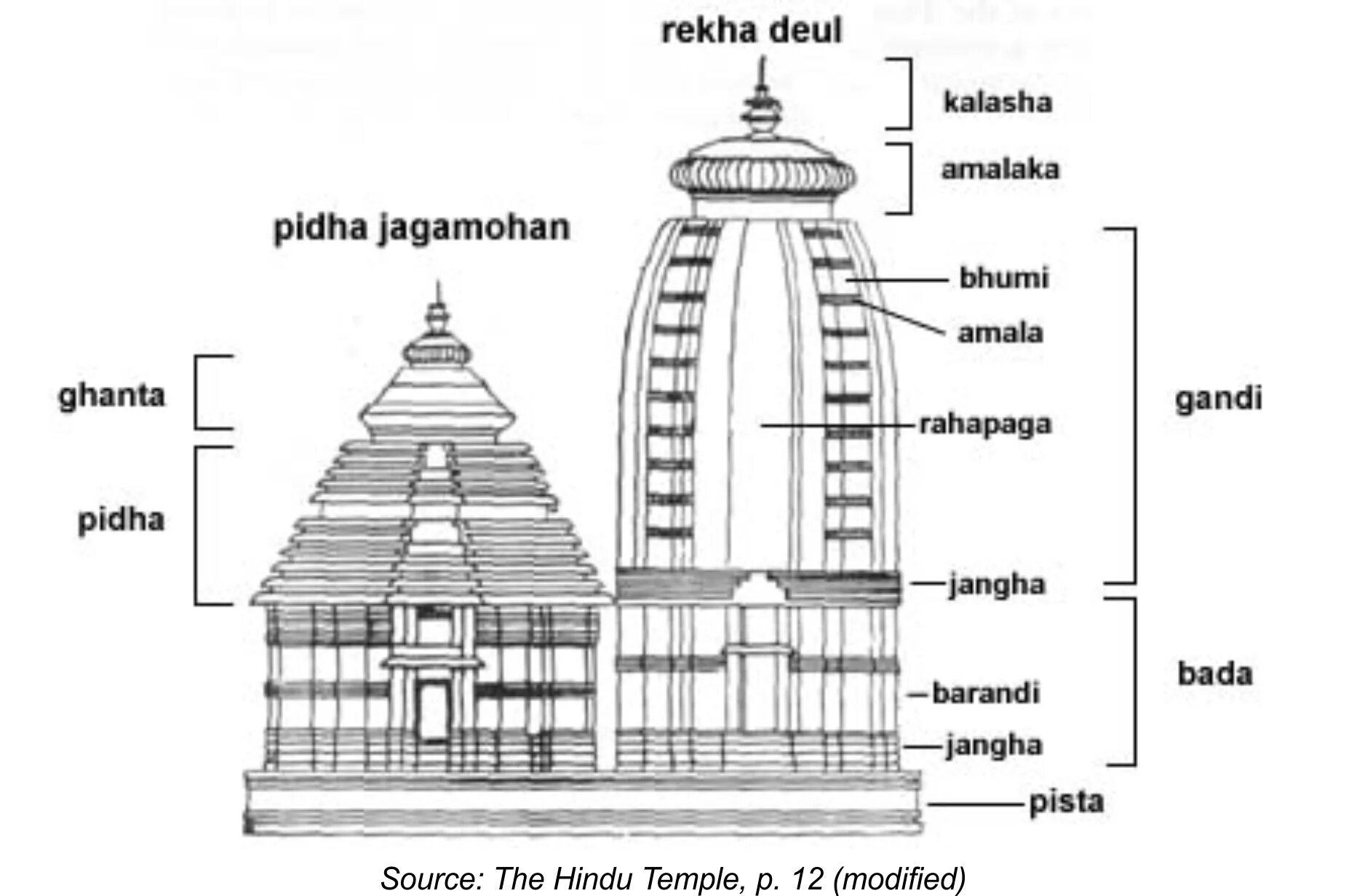
The Rekha Deul (curvilinear Vimāna) beside the Piḍha Jagamohana (pyramidal porch). Labels show the canonical vertical divisions: Piṣṭa, Bāḍa (Jaṅghā, Bāraṇḍi), Gaṇḍi (Rāhapāga, Amala, Bhūmi), and Kalaśa — as described in the Odishan Śilpa Śāstras. Exemplified by Jagannātha Purī, Liṅgarāja, and Koṇārka.
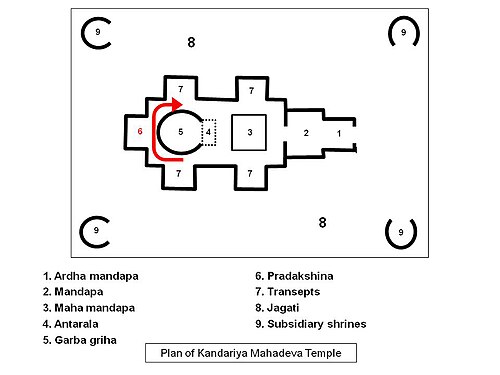
A fully developed Nāgara Pañcaratha plan. The axial sequence — Ardha-Maṇḍapa (1), Maṇḍapa (2), Mahā-Maṇḍapa (3), Antarāla (4), Garbhagṛha (5) — is flanked by Pradakṣiṇā passage (6), lateral Transepts (7), Jagati platform (8), and subsidiary shrines (9). This is the cosmogram made habitable: the devotee's procession through the plan re-enacts the soul's journey from the periphery of manifestation to its divine centre.
Section II
The Concept of Poorta — Righteous Civic Merit
Hindu Dharma classifies meritorious action into two streams. Ishta refers to private sacrificial rites performed for oneself and one's family — Vedic yajnas, personal vratas, ritual observances. Poorta encompasses public acts of welfare whose fruits extend outward to the community — constructing water-tanks (vapi, kupa, tadaga), rest-houses (dharmashalas), planting gardens (arama), and building temples. Of all Poorta works, temple construction is declared the highest.
देवानां च कर्तव्याः प्रासादाः शुभलक्षणाः ॥
devānāṃ ca kartavyāḥ prāsādāḥ śubhalakṣaṇāḥ ||
The Dharma Shastra tradition, as codified in Manu Smriti and Yajnavalkya Smriti, places Poorta-karma in a special category of deeds that generate inexhaustible merit (akshaya punya) — because the deed continues to benefit others long after the doer has left the body. The merit accumulates as long as the structure stands and as long as it serves its purpose. This is why durability of materials — stone, granite, fired brick — is itself a spiritual consideration.
Section III
Benefits for the Builder — Karta Phala
A. Merit Proportional to the Longevity of the Structure
The Agni Purana (Chapter 38) quantifies the spiritual merit of temple-building with remarkable precision, linking it directly to the durability of the structure itself:
तावद्वर्षसहस्राणि तत्कर्तुर्दिवि संस्थितिः ॥
tāvadvarṣasahasrāṇi tatkarturdivi saṃsthitiḥ ||
The multiplier — one year of structural survival equals a thousand years of heavenly residence — signals that construction in durable materials (stone rather than wood, granite rather than brick) is itself an act of spiritual amplification. The builder who invests in quality is investing in greater punya.
A.2 — Hands Dedicated to the Temple: The Model of Ambarisha
The Bhagavata Purana presents the ideal of total bodily dedication to temple service through the account of Emperor Ambarisha — where every limb of the devotee is enlisted in divine worship. The verse is one of the most celebrated in the Bhagavata tradition on the place of the temple in spiritual life:
वचांसि वैकुण्ठगुणानुवर्णने ।
करौ हरेर्मन्दिरमार्जनादिषु
श्रुतिं चकाराच्युतसत्कथोदये ॥
vacāṁsi vaikuṇṭha-guṇānuvarṇane |
karau harer mandira-mārjanādiṣu
śrutiṁ cakārācyuta-sat-kathodaye ||
The verse is the first of a three-verse sequence (9.4.18–20) in which every faculty — mind, speech, hands, ears, eyes, touch, smell, tongue, feet, and will — is redirected toward some form of service to God. Mandira mārjanādi — "the sweeping and other service of the temple" — is specifically named as the proper occupation of the hands. This places physical maintenance of the temple alongside the highest forms of devotion.
A.3 — The Lord Himself Commands: Temple Installation and Service (Bhagavata Purana 11.11.38–39)
In the Uddhava Gita section of the Bhagavata Purana (Skanda 11), the Lord speaks directly to Uddhava about the signs of a devotee. Among them, He names faithful installation of His deity and devoted service to the temple:
उद्यानोपवनाक्रीड-पुरमन्दिरकर्मणि ।।
सम्मार्जनोपलेपाभ्यां सेकमण्डलवर्तनैः ।
गृहशुश्रूषणं मह्यं दासवद्यदमायया ।।
udyānopavanākrīḍa-pura-mandira-karmaṇi ||
sammārjanopalepābhyāṃ seka-maṇḍala-vartanaiḥ |
gṛha-śuśrūṣaṇaṃ mahyaṃ dāsa-vad yad amāyayā ||
The verse explicitly names pura-mandira-karmaṇi — "works of cities and temples" — and sammārjana-upalepa — "sweeping and smearing (the floor)" — as direct acts of devotion to the Lord. The phrase dāsa-vad amāyayā ("like a guileless servant") establishes that the motivation must be free from ulterior purpose. Temple construction and temple service are here treated as identical in spiritual value to internal meditation.
A.4 — The Eight Forms of Sacred Image (Bhagavata Purana 11.27.12)
The Bhagavata Purana's authoritative chapter on deity worship (Skanda 11, Chapter 27 — the Arcana-vidhi) opens by enumerating eight valid forms in which the Lord may be housed and worshipped. The breadth of this list is significant: it extends the permission to build and consecrate images across every material available to a community, from stone quarried from mountain to sand formed by the hand:
मनोमयी मणिमयी प्रतिमाष्टविधा स्मृता ।।
manomayī maṇimayī pratimāṣṭavidhā smṛtā ||
The doctrinal point of this enumeration is that the divine may be housed in any suitably consecrated form — from a carved stone icon within a grand Prasada to a mental image held during meditation. The verse legitimises the full spectrum of sacred space from the grandest temple to the simplest earth-mound. It also confirms that the critical criterion is not material wealth but proper consecration and devotion.
The following verse (11.27.13) further distinguishes between two kinds of installation — calā (moveable, not permanently fixed) and acalā (fixed, the living-temple deity: jīvamandiram, literally "the living temple"). For the fixed image in a proper temple, the text prescribes that neither the udvāsa (removal of the deity) nor the āvāhana (invitation of the deity) rituals are applicable — the divine presence is considered permanently established.
A.5 — Devotion Outweighs Wealth: What Truly Pleases the Lord (Bhagavata Purana 11.27.17–18)
भूर्यप्यभक्तोपाहृतं न मे तोषाय कल्पते ।
गन्धो धूपः सुमनसो दीपोऽन्नाद्यं च किं पुनः ।।
bhūryapyabhaktopāhṛtaṃ na me toṣāya kalpate |
gandho dhūpaḥ sumanaso dīpo'nnādyaṃ ca kiṃ punaḥ ||
This verse supplies the theological foundation for the capacity principle established in the Agni Purana (Ch. 327): the divine economy is not indexed to monetary value but to śraddhā (faith) and bhakti (devotion). A poor builder who raises a temple of eight bricks with full sincerity stands exactly on a par with a wealthy patron who erects a temple of gold with less — or without — devotion.
B. Graduated Scale of Benefits (Agni Purana, Chapter 38)
The same chapter lays out a graduated scale of the worlds attained by those who build different numbers of temples:
From Agni Purana Ch. 38 — Verified Translation (Gangadharan / Motilal Banarsidass)
The text also states explicitly (Ch. 38, v. 6): "Whichever benefit could not be obtained by performing sacrificial rites could be obtained by erecting an abode for the god. He who erects an abode for the god reaps the fruits of bathing in all holy waters."
C. The Material Used Multiplies the Merit — Narada Purana
The Narada Purana (Chapter 13, Dharma Anukathana) provides a graduated scale of merit based on the material used in construction — supplementing the Agni Purana's scale with another dimension of quantification. It confirms the cosmic scope of the benefit: the builder travels in a divine vehicle, dwells in Vishnu's region for multiple Kalpas, and reaches eventual liberation.
v.6–7: He assumes a lustrous divine body and travels by an excellent heavenly vehicle. After residing in Vishnu's region for three Kalpas, he proceeds to Brahma's capital.
v.7–8: After two more Kalpas there, he resides in the celestial world for one Kalpa. He is thereafter born in a family of Yogins and attains eternal emancipation.
Scale by material used: Temple of earthen material → three Kalpas in Vishnu's region. Temple of wood → merit doubled. Temple of brick → merit tripled. Temple of stone → merit fourfold. Temple of crystal slabs → merit tenfold. Temple of copper → merit hundredfold. Temple of gold → merit ten millionfold.
The Narada Purana also emphasises continuity of service: those who maintain the temple through sweeping, smearing, sprinkling, or embellishing it with devotion "derive infinite merit" — and those who serve it even for a wage attain Vishnu's eternal region perpetually (Ch. 13, v. 10b).
D. The Capacity Principle — Agni Purana, Chapter 327
The Agni Purana returns to the subject of temple-building in Chapter 327, now in the context of Shiva Linga consecration, with an important universal principle: the spiritual merit of building a temple is not relative to the scale of construction, but to the capacity of the builder.
The theological point is clear: the divine economy is not a market where only the wealthy can participate. The act's value lies in proportional sacrifice and sincere devotion, not in rupees spent. The Narada Purana (Ch. 13, v. 15–16) similarly confirms that a rich man building a large tank and a poor man digging a well earn equal merit.
F. Purification of the Gravest Sins
Agni Purana Chapter 38 further states that the erection of the abode for the deity destroys sins including even the killing of a Brahmin (Brahmahatya — the gravest ritual offence in the Dharma Shastra scale). This is one of the most direct statements in Puranic literature of the transcendent magnitude of temple-building as a purifying act.
G. Superior to Sacrifice
The same chapter asserts that the building of a temple yields benefits that sacred sacrificial rites alone cannot generate — an extraordinary claim that elevates Poorta above Ishta in this context, because the temple's benefit extends infinitely beyond the moment of its construction.
Section IV
Benefits for Ancestors and Lineage — Pitru Uddhara
The Agni Purana Chapter 38 states directly that when a person builds a temple for Hari, he "immediately conveys a lakh of his ancestors both past and future to the world of Vishnu." The Pitaras (ancestors), having seen the temple built by their descendant, are released from any suffering in lower realms and dwell honoured in Vishnu's world. The text adds: "The manes of a person who builds a temple for Vishnu, having seen it, remain in the world of Vishnu well-honoured and relieved of their sufferings in hells."
Section V
Eligibility — Who May Build, and the Purity of Wealth
A. Dravya Shuddhi — The Purity of Wealth
The Dharma Shastras are unambiguous: the spiritual merit of any Daana (donation) or Nirmana (construction) is entirely contingent on the purity of the wealth used. Only Nyayoparjita Vitta — wealth earned through righteous and just means — is fit for sacred purposes.
श्रद्धाकृते ह्यक्षये ते भवतः स्वागतैर्धनैः ॥
śraddhākṛte hyakṣaye te bhavataḥ svāgatairdhanaiḥ ||
The commentary of Medhatithi (the foremost classical commentator on Manu) is explicit: acts performed with wealth not well-gotten yield only transitory results, not the imperishable merit spoken of in this verse. The word svāgata — "properly come," or "legitimately acquired" — is the operative qualifier. Medhatithi categorises wealth into three types: śuddha (pure, from learning, bravery, gifts, inheritance), miśra (mixed, from agriculture, trade, service) which yields transitory merit, and kṛṣṇa (black, from bribery, theft, fraud, violence) which actively corrupts the act of donation.
B. Who Has the Adhikara (Right) to Build?
The Agamas are notably inclusive on the question of who may build a temple. The Kamika Agama specifies that the Yajamana (primary patron) must be a person of upright moral standing — a householder of good conduct, acting from devotion rather than pride. Social category is explicitly secondary to inner orientation and purity of means.
The Vishnu Purana tradition goes further, affirming that even a person of humble social standing who builds with pure wealth and sincere devotion attains liberation — the Bhagavata tradition consistently subordinates varna to the quality of surrender and devotion.
C. The One Condition That Is Non-Negotiable
Across all the texts — Agamas, Puranas, and Dharma Shastras — the one consistent requirement is Shraddha: sincere faith and reverential intention. A temple built purely for social status or public recognition, with no devotional core, is considered spiritually hollow. Yet even here, the Bhagavata Purana's theology gently suggests that proximity to the sacred tends, over time, to purify even impure motivations — so the act retains some value even when the intention is mixed.
Section VI — Illustrated
Temple Plans — The Sacred Architecture
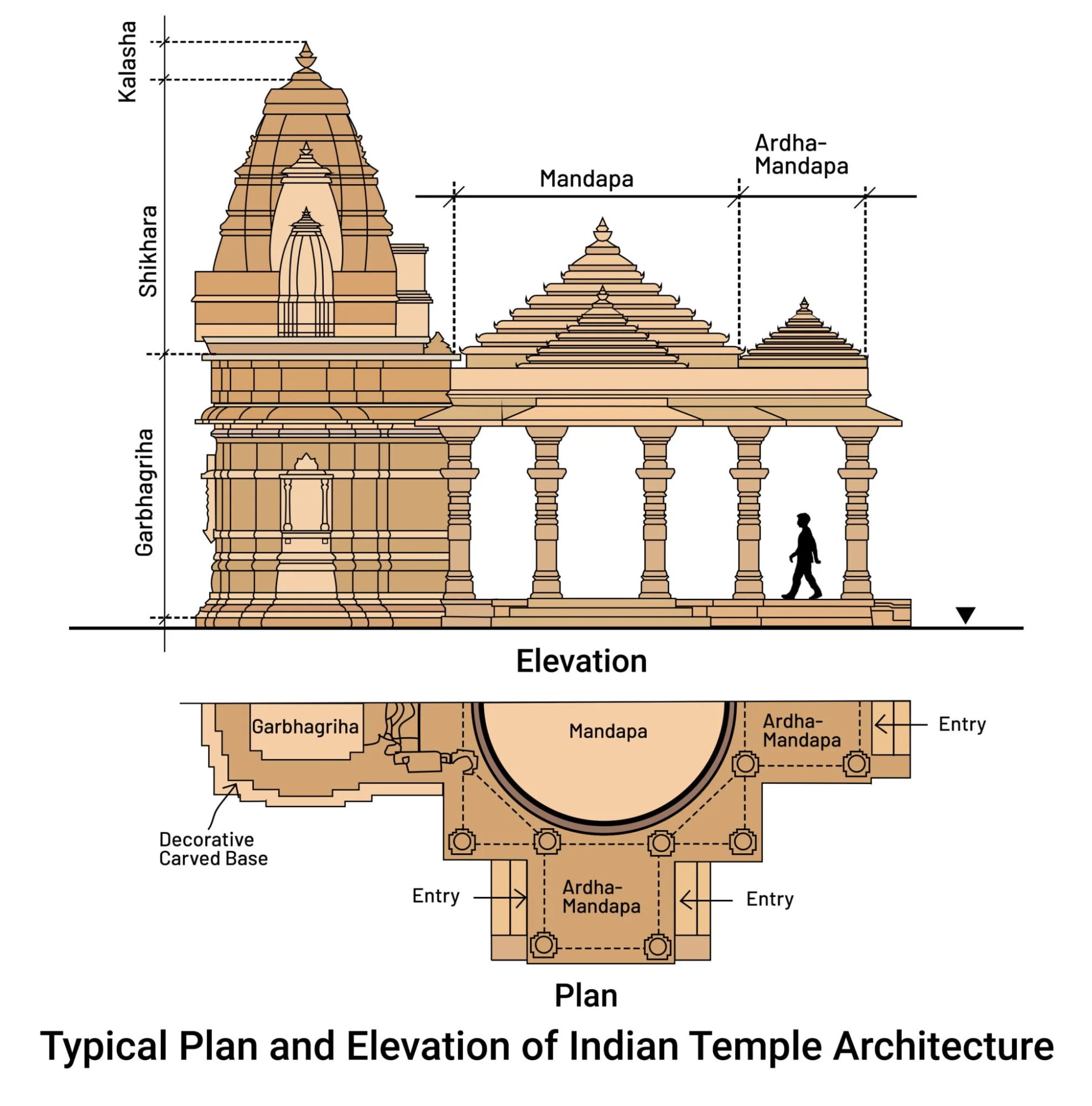
Every Agama-compliant temple follows a precise architectural logic rooted in the Vastupurusha Mandala — a cosmic grid that maps the divine body onto the building site. Below are two canonical plan types.
Section VII
Procedures — The Correct Method of Construction
A. Site Selection — Bhumipariksha
The Manasara and Mayamata Shilpa Shastras prescribe rigorous testing of the earth before any construction. The ground must actively support life — seeds sown in a test plot must sprout vigorously within a set period. The water-table must be sound, the soil dense, the site free of inauspicious history. A qualified Sthapati (traditional architect-priest) is essential for this evaluation. The Agni Purana (Ch. 42) begins its construction instructions with the instruction that a wise man should first carefully assess and divide the chosen square ground before any other step.
B. The Vastupurusha Mandala
All Agama-compliant temple construction is oriented upon the Vastupurusha Mandala — the sacred geometric grid that maps the cosmic being (Vastupurusha) onto the building site. The Kamika Agama (Purva Pada) provides chapter-length treatment of the grid's zones, the deities governing each zone, and the specific structural elements assigned to each. No structural placement is arbitrary; every column, corridor, and subsidiary shrine is in precise correspondence with this cosmological map.
C. The Sthapati and Shilpi — Consecrated Craftsmen
The Vishnu Dharmottara Purana devotes an entire section (Chitrashastra) to the qualifications of craftsmen. The Sthapati must be learned in the Vedas and Agamas, observant in his own daily ritual conduct, and formally initiated into the craft-tradition. A temple built by unconsecrated hands, or by those who treat the work as ordinary masonry, is considered deficient in its subtle structural quality — the Agamic term is Kshata Prasada (a compromised Prasada).
D. Consecration — Prana Pratishtha
Without Prana Pratishtha — the formal installation of the divine consciousness into the idol and the temple structure by a qualified Agama-trained priest — the temple remains a beautiful but inert structure. The Agamas treat this ceremony as the single most important event in the entire building process.
E. Daily Ritual Continuity — Nitya Puja Vyavastha
The Agamas are unanimous and emphatic on this point: a consecrated temple in which daily worship ceases becomes a site of negative spiritual energy rather than positive. The Suprabhedagama specifically warns that a temple in which the lamp (nanda deepa) has been extinguished and daily rites abandoned becomes a dwelling of bhutas (disembodied entities) hostile to human welfare. This is why the Agamas require that the founding Yajamana provide a perpetual endowment (nitya daana) for the sustaining of daily rites as a prerequisite to Prana Pratishtha being performed.
Section VIII
Temple Restoration — Jeernoddhara
Jeernoddhara (restoration of a dilapidated temple) is treated by the Vishnu Dharmottara Purana and the Agamas as a deed of merit equal to — or in certain conditions greater than — building a new temple. The theological reasoning is precise: an old temple has an existing sannidhi — a field of accumulated divine presence built up through centuries of uninterrupted worship. Restoring it is not merely a construction act but the rescue of a living sacred entity.
The Agamas treat the neglected temple as a person in distress and the restorer as a protector (rakshaka) who earns the gratitude of all beings — human, divine, and ancestral — who benefited from its previous activity. This principle has direct and urgent practical relevance today, as thousands of ancient temples across India await restoration far more urgently than new structures are needed.
Section IX
Sustaining a Temple — Nitya Daana and the Nanda Deepa
Even those unable to build or restore a temple have significant avenues of merit through acts that sustain living temples:
Donating land to a temple for its sustenance (Bhu Daana) is described across the Puranas as generating merit for as long as the temple uses that land — one of the most enduring forms of karmic benefit a householder can create.
Section X
The Temple as the Civilizational Centre
The Agamic tradition never separated the sacred from the civic. The living temple historically served as the educational, economic, judicial, medical, and cultural nucleus of the community. The Vishnu Dharmottara Purana's Chitrashastra makes this explicit: the temple is a text written in stone, accessible to all regardless of literacy, designed to transmit Dharmic knowledge across generations through narrative sculpture, iconography, and ritual drama.
Section XI
Additional Śāstric Testimony — Garuda Purāṇa, Padma Purāṇa & Vishnu Purāṇa
A. The Garuda Purana on Image Worship and Liberation
The Garuda Purana (Acara Khanda) addresses the installation of deities and the establishment of sacred shrines as direct paths to liberation. Its teaching is consistent with the Bhagavata: the deity installed with proper rites becomes a living vehicle of divine grace, and the builder participates permanently in that grace-field.
B. The Padma Purana on Tirtha Mahatmya and Temple Service
The Padma Purana (Svarga Khanda) devotes extensive chapters to the relationship between temples, sacred places (tirthas), and the accumulation of merit. It teaches that a temple established at a natural tirtha (riverbank, mountain, confluence) multiplies the merit of construction manifold — and that serving at such a temple during auspicious periods confers liberation even for those with accumulated karmic burdens.
C. The Vishnu Purana on the Eternal Merit of Temple-Building
तावद् देवालयं कृत्वा स्वर्गे स्थास्यति कारकः ।।
tāvad devālayaṃ kṛtvā svarge sthāsyati kārakaḥ ||
This verse is one of the most widely quoted in the tradition of temple-building (devalaya nirmana). It invokes permanence not of human structures but of cosmic geography — mountains and oceans — as the measure of the builder's merit. The theological statement is that the act of building a temple for the divine aligns the builder with the eternal rhythms of the cosmos itself. Even after the individual structure crumbles, the karma of construction endures in the heavenly realms like a cosmic inscription.
D. The Varaha Purana on Smearing and the Merit of Lepa
The Varaha Purana contains a remarkable episode on the merit of even the humblest act of physical service to a temple. A Shudra who inadvertently smeared (lepa) a broken and abandoned Vishnu temple with cow-dung — simply from habit, not knowing it as a temple — was reborn as a great king of Ayodhya in a subsequent life. The Purana uses this episode to establish the principle of unconscious temple merit: even uninstructed service renders reward, because the divine presence in the image responds to the act independent of the actor's intention.
The Vishnu Dharmottara Purana cites this narrative to conclude: "Therefore, those who knowingly serve the temple — who understand what they are doing and why — earn proportionally greater merit. But the unconscious act itself is not unrewarded. The divine is never ungrateful."
Conclusion
A Final Word on Eligibility and Humility
The scriptural tradition is simultaneously demanding and inclusive. It is demanding in its insistence on the purity of wealth, the correctness of procedure, and the sincerity of intention. It is inclusive in that it does not restrict the right to build or support a temple by birth — several Agamas describe the merit of women donors in terms equal to men, and the Vishnu Purana extends the highest benefit to the devoted regardless of social station.
The one consistent requirement across all texts is Shraddha — sincere faith and reverential intention, not the purchase of public respect. The divine, the texts suggest with consistent voice, is not deceived by the externals of donation when the interior is hollow. But neither is it unmoved by even a small act performed with a full heart.
The temple is, ultimately, the universe made intimate — a place where the formless takes form so that the embodied may encounter the transcendent. Its construction, maintenance, and sustenance are among the most complete acts a human being, a family, or a community can perform in the world.